
Harvest Machinery offers a complete line of tire shredders and recycling equipment, which are designed to process scrap tires for recycling and reuse in a variety of applications.
With years of experience developing equipment that provides high quality rubber from scrap tires, Harvest tire shredders and ancillary equipment provide cost-effective options for shredding tires, separating rubber from steel and generating granulated or powdered rubber for recycling.


Application of tire recycling machine end products
- 8-20 mesh: can be used for runway, road mat, padding, turf, road elastic layer and other sports venues.
- 30-40 mesh: It can be used for producing recycled rubber, flat plate, modified rubber powder, etc.
- 40-60 mesh: known as fine powder, mainly used for filling rubber products, plastic modification, etc.
- 60-80 mesh: superfine powder, mainly used for car tires, rubber products, building materials, etc.
Tire recycling process
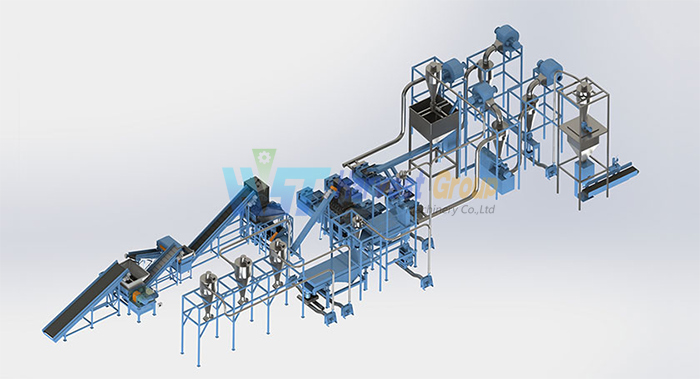
All kinds of waste tires can be processed into granules or rubber powder; the required fineness (mesh) can be adjusted according to different requirements. The main process includes tire drawing, shredding, rubber granulation, fiber separation, rubber grinding and sieving, etc.
- Tire drawing machine: pulls out the wire from the rim so that the tyre can be shredded directly by the shredder in the next process.
- Tire Shredder: the shredder shreds the whole tyre after drawing into 3-8 cm rubber pieces.
- Rasper: the rubber blocks are processed into rubber granules of 10-30 mm and the steel wire is separated from the rubber at the same time.
- Screening machine: sorting of rubber granules of different sizes, oversized granules are returned to the shredder for secondary shredding.
- Magnetic separator: removes any remaining fine steel wire.
- Rubber granulator: the rubber from the rubber granulator can be crushed to a particle size of 1-6 mm. The granules are then screened and circulated to reach even finer sizes. Due to the special design of the granulator, high quality granules of uniform size are produced and 99% of the fibres are removed during the granulation process.
- Fibre separator: foreign matter and fibres are removed.
- Rubber miller: the miller can grind granules from 1-6 mm into fine rubber powder from 30-120 mesh as required. Easy to operate, with high speed grinding discs running continuously.
Tire recycling market has a promising future
Scrap tires are facing unique recycling and disposal challenges because they are bulky and made of multiple materials, and the use of scrap tires is becoming a top priority in many countries. What are the current recycling methods? Generally speaking, there are three main methods of recycling tire scrap, namely tire-derived fuels, ground rubber applications and civil engineering.
In the first application, burning tires releases a compound called tar that can be used as a cleaner and more economical alternative fuel to coal in paper mills, industrial boilers, etc. Ground rubber applications include new rubber products, sports fields and other athletic surfaces, and rubber-modified asphalt. As for civil engineering, these tire scraps are often shredded and then used for road and landfill construction, septic leach fields, etc.
Of the three, incineration can keep scrap tires out of landfills even though it can help reduce dependence on fossil fuels. It is far from ideal due to its inefficiencies and emissions problems. Tire shredding is currently a better prospect than other applications. For those who want to start a tire recycling business, they may be concerned about its market. In fact, recycled rubber is already widely used in many applications such as sports surfaces, automotive industry, construction, geotechnical/asphalt applications, adhesives and sealants, vibration damping and safety products, rubber and plastic products, etc.